The morning air carries a hint of salt. It’s not the heavy saltiness of the open sea, but something gentler, brought in by a breeze from the harbor and blending with the steam from a coffee kiosk behind me. I’ve only walked five minutes from Kongens Nytorv when the canal appears ahead, like a picture from a book I half-remember. Suddenly, I realize I’ve carried this image in my mind for years without knowing its source.
Nyhavn
It starts with color. Not just one, but a lively mix—ochre, rust, pale blue, and deep terracotta—lining the north quay in a row of narrow gabled facades, each one painted as if by someone in a different mood. The buildings rise four or five stories, with small, even windows climbing toward Dutch-style roofs. Their reflections stretch into the water below, rippling where a tour boat has just passed, so the canal holds a softer, more impressionistic version of the scene, with the colors blending at the edges.
The boats tied up along the quay are old wooden vessels: dark hulls, ropes coiled on their decks, and a faint smell of tar and damp wood. They don’t look like they’re going anywhere, and that’s intentional. Since 1977, when the quay became a veteran ship and museum harbor, these boats have stayed put as monuments to a working life that has moved on from this waterway.
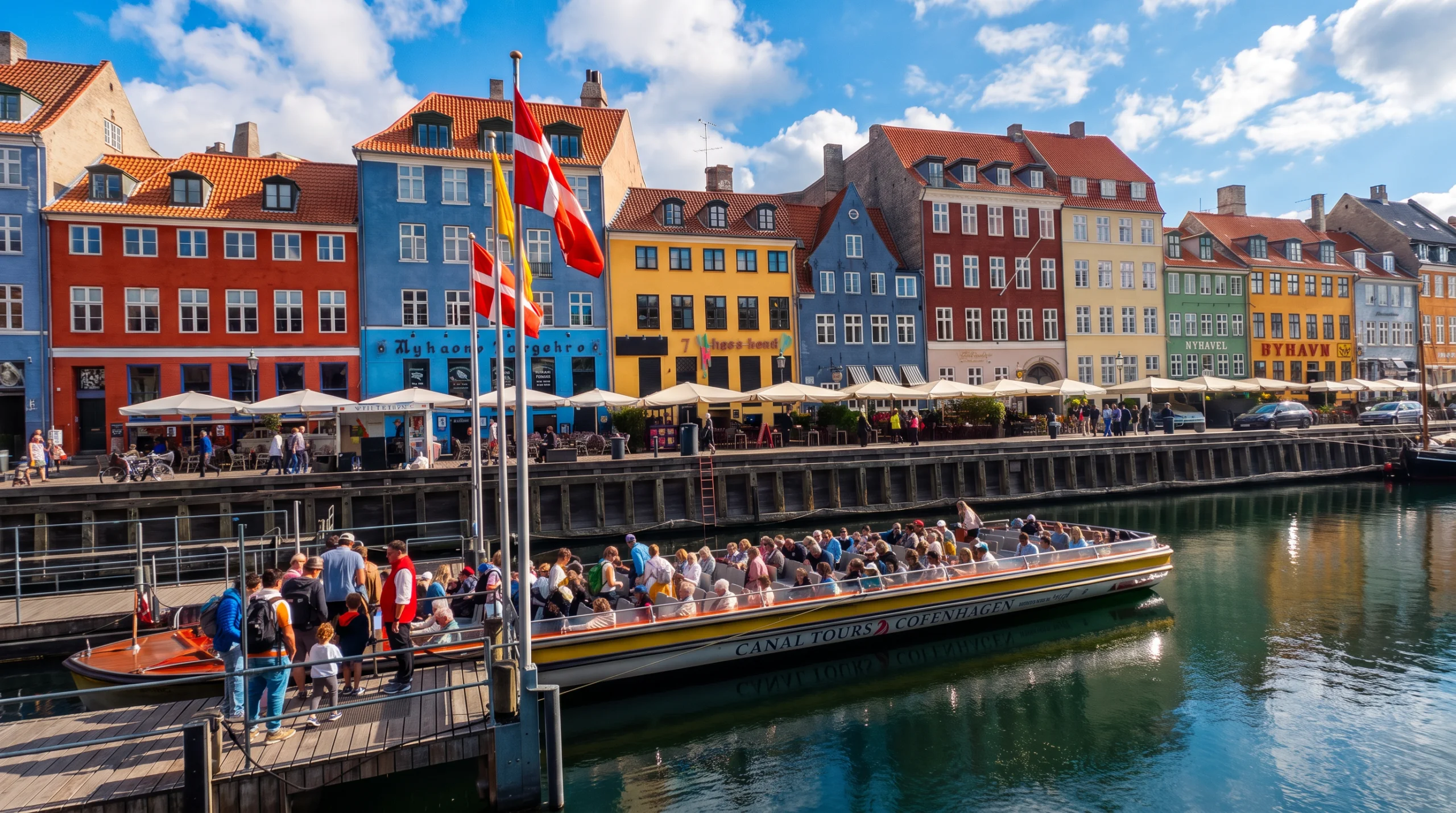
What I see in front of me—tourists at café tables, smoked herring on menus, and the same postcard image on about eleven stands nearby—is so different from what this place used to be that it takes a moment to hold both versions in my mind.
Nyhavn was dug between 1670 and 1673 on the orders of King Christian V. The labor was performed partly by Swedish prisoners of war, captured during the series of conflicts that defined this part of northern Europe in the seventeenth century. Its purpose was entirely practical: to cut a navigable channel directly into the city's heart, giving merchant ships access to the market at Kongens Nytorv and relieving pressure on the older harbor. For nearly three centuries, it was a working sailor's quarter — not the charming kind, but the rough and frequently disreputable kind, dense with taverns, rooming houses, pawn shops, and the provisional energy of a place where men arrived from sea and needed somewhere to spend their wages. Hans Christian Andersen lived here, at numbers 20, 67, and 18 along the canal at different points in his life — and it was at number 20 that he published his first fairy tales, in 1835. It's tempting to imagine him writing by a window above all that noise and difficulty. Probably he just found it cheap.
The transformation came slowly. Post-war shipping moved elsewhere; the harbor traffic that had defined Nyhavn for centuries dried up. By the 1960s, the quay had become something of a backwater, its reputation fraying. The Nyhavn Society was formed in 1966 with the aim of revitalizing it. The quayside was pedestrianized in 1980, and gradually, the restaurants arrived, the outdoor tables appeared, and the area settled into its current identity as one of the most photographed corners of northern Europe.
There is nothing dishonest about this transformation, exactly. The buildings are genuinely old. The wooden ships are real. And yet standing here on a bright morning, watching a man take a photograph of his coffee against the backdrop of the canal, I can feel how thoroughly the present has overwritten the past. The grit has been removed so cleanly that what remains is only the picturesque surface.
I order coffee at a place on the south quay, which is slightly quieter and mostly shadowed at this hour. The chairs are metal and the tables are small. Across the water, sunlight hits the upper facades of the painted buildings directly, making the colors sharper and slightly unreal. A cyclist rings her bell somewhere behind me and doesn't slow down. I stay for perhaps twenty minutes, watching the morning settle in.
Walking away from Nyhavn, the city changes within a few hundred meters.
The tourists become fewer. The streets get narrower. I walk through a short block where the ground floors hold a pharmacy, a dry cleaner, and a plain café where two older men read newspapers at separate tables. One building is covered in scaffolding, its facade showing a warm, peeling yellow underneath—the kind of color likely chosen two centuries ago and left to fade a bit more with each decade.
Bicycles are everywhere. Not just the occasional bike—not the flashy, performance types you see in cities where cycling is still a statement—but regular bikes ridden by regular people going about their day. A woman in a raincoat rides by with a child seat on the back and a bag of vegetables over the rear wheel. A man in a suit cycles past with a briefcase strapped to his rack. A teenager rides with one hand and holds a phone with the other, which is probably illegal, but he does it calmly.

This is what happens when cycling is part of the city’s infrastructure, not just a subculture. Copenhagen’s connection to bicycles goes back a long way—tracks and lanes were already being built in the early twentieth century. The real change came after the 1973 oil crisis, when the city, like much of northern Europe, started to rethink what it had built since the war. The car-focused planning model, borrowed from American cities, was questioned more and more. By the 1980s, a proposal for an inner-city motorway was stopped by widespread protest, and the city’s direction began to shift. Today, about half of all commuter trips in Copenhagen are made by bicycle—not as a political statement, but simply because it’s the most practical way to get around a city built for bikes.
What stands out to me, as I stand on a corner and watch the flow, is how ordinary it all seems. No one looks like they’re trying to make a statement. They’re just getting where they need to go. Here, the bicycle is what the car is in other cities: the obvious choice, something you use without a second thought. The city shows this too—the bike lanes are wide, continuous, and clearly prioritized, and there’s a calm at street level that only happens when the main vehicle is slow and quiet.
I keep walking north.
Frederiksstaden reveals itself slowly. The streets get wider. The architecture feels more intentional—less like the patchwork of a city that grew over time and more like the careful design of a city planned all at once. The facades are pale and symmetrical, made of stone ashlar instead of painted plaster, and there’s a sense of authority in the proportions that comes from the scale of the whole area, not any single building.
Then the square opens up.
Amalienborg Slotsplads is octagonal, which is unusual, and you notice the shape before you even think about it. It feels like you’re inside something complete and carefully planned. Four palaces frame the square, one on each main side. From the outside, they look almost the same: pale yellow-grey stone, mansard roofs, and similar arrangements of windows and pilasters with only slight differences. At the center stands an equestrian statue of King Frederick V, cast in bronze and raised high enough to be seen from every side of the square.

The complex was built in the 1750s as part of Frederiksstaden, a project commissioned by King Frederick V to mark the 300th anniversary of the Oldenburg family's accession to the Danish throne. The court architect Nicolai Eigtved designed the district and the palaces, which were originally built for four noble families and stood for several decades as aristocratic townhouses. The royal family didn't move in until 1794, when Christiansborg Palace burned down and the monarchy found itself without a residence. They acquired two of the palaces within days of the fire and have been there, essentially, ever since.
The equestrian statue of Frederick V in the center of the square was commissioned from the French sculptor Jacques Saly and took more than twenty years to finish. It’s still seen as one of the best equestrian sculptures in Europe, though that isn’t obvious at first glance. What stands out is its presence: the horse’s paused movement, the king’s outstretched arm, and the way the statue commands the space without dominating it.
What I didn't expect, standing here, is how accessible it all feels. There is no fence around the square. No ticket booth, no queue, no velvet rope. Tourists walk through it freely. Guards in tall bearskin hats stand at intervals, but they are still and formal and do not interact with anyone unless something is actively wrong. A couple eats lunch on a bench near the statue. A child runs across the cobblestones. A delivery van crosses one corner of the square and disappears.
This is a working royal palace in an ordinary European city, and the connection between those two facts is more interesting than either one alone. The Danish monarchy is one of the oldest in the world and also one of the least showy. There’s no elaborate security, no clear effort to separate the palace from the city. The square is just there, open and part of the neighborhood, with flags above showing which palace the royal family is in. It feels like an institution that has learned, over a long time, how to live alongside a democracy.
The walk from Amalienborg to the waterfront takes only a few minutes. The square opens eastward through a gap between the palaces, and through that gap you see it: the harbor, the Opera House on its artificial island across the water, the sky.
The light over the harbor is shifting. It has that special quality northern light sometimes gets in late morning—very clear and a bit cool, making everything look sharper than you’d expect, with every edge and surface standing out. The water is a dark greenish-grey, moving in small, uneven patterns from the wind. Sailing boats are anchored farther out, their white hulls bright against the water, and a harbor bus moves steadily toward the other shore.

This part of the waterfront, north of Nyhavn and east of the old city, feels different from the canal. It’s less staged. The people walking along the promenade are a mix: some tourists with cameras, but also people who seem to work nearby, eating lunch on benches or checking their phones. A pair of joggers pass by without paying attention to the view. Children toss bread to ducks that have no interest in being photographed.
Copenhagen was built on water and shaped by it, and the harbor’s role in the city’s identity goes beyond just being pretty. The Øresund Strait, which separates Denmark from Sweden, made this harbor one of the most important in northern Europe for centuries. The tolls Denmark collected from ships passing through the strait between the fourteenth and seventeenth centuries made the monarchy rich enough to build things that are still here today—Nyhavn, Frederiksstaden, Amalienborg. The water wasn’t just scenery; it was the driving force.
What stands out now is how the city has turned back to face the harbor after years of ignoring it. Like many industrial waterfronts, Copenhagen’s fell into disrepair as shipping changed and moved farther away. The renewal of the inner harbor—the cleaning of the water, the building of waterfront promenades, and the opening of harbor swimming baths in the early 2000s—is part of a bigger story about how a post-industrial city decides what it wants to be.
Standing at the water’s edge, watching a harbor bus approach its stop with steady patience, I think about what cities choose to keep and what they let go. Nyhavn kept its buildings and boats but erased much of the history that shaped them. Amalienborg kept its palaces open and the monarchy present, without making either feel distant or odd. The waterfront, of course, kept the water, and then slowly decided to treat it as something to face, not turn away from.
I walk back through the city in the early afternoon, retracing roughly the route I came by, but nothing looks quite the same in the different light. The canal at Nyhavn is busier now, the café tables full, a queue for a harbor boat stretching along the south quay. The streets between the waterfront and the center are warmer, the shadows shorter. A bicycle passes close enough that I take a half-step back without thinking.
What I remember later isn’t any one building or view. It’s more of a feeling—a special balance between history and everyday life that Copenhagen seems to handle with ease. The palaces stand in the same city as the bike lanes. The canal, once dug by prisoners of war in the seventeenth century, is now a place to have coffee on a Tuesday morning. The king’s residence opens onto a cobblestone square where delivery vans pass by without fuss.
In most cities, history stays in one place and life in another. Here they seem to have simply continued, side by side, each making small adjustments for the other's presence, until neither one could quite remember when it had been any different.