
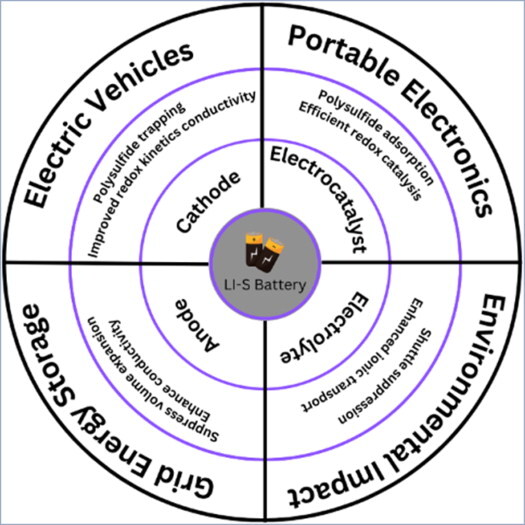
Lithium-sulfur (Li-S) batteries demonstrate potential as energy storage solutions because they provide high theoretical energy density along with cost-efficiency and access to plentiful sulfur materials. Li-S batteries demonstrate potential as an effective substitute for LIBs because their unique advantages make them suitable for both electric vehicle applications and grid energy storage needs. Li-S batteries encounter major obstacles from the polysulfide shuttle effect along with sulfur’s poor conductivity and structural degradation during cycling, which leads to quick capacity loss together with reduced cycle life and inefficient Coulombic efficiency. New developments in material science and engineering fields have produced innovative approaches to tackle existing issues. Advanced cathode architectures with conductive carbon scaffolds represent one primary approach, while modified separators suppress polysulfide diffusion and functional coatings improve sulfur utilization together with better interfacial stability. The implementation of solid-state electrolytes alongside electrocatalytic materials and hierarchical porous structures has produced substantial enhancements in energy density and both cycling stability and rate capability. Battery management systems combined with computational modeling techniques provide a valuable understanding of reducing mechanical stress and enhancing system performance. The review presents an overview of Li-S battery development achievements while identifying ongoing research obstacles and calling for combined mechanical, chemical, and electrochemical approaches to resolve these issues. Current limitations exist for commercial implementation, but ongoing developments in Li-S technology hold transformative potential to create sustainable, high-performance storage systems across numerous industrial applications.
🔗 Read full paper